


What’s the Difference Between the 2026 Chevy Tahoe & Suburban?
If you’re looking for a reliable full-size SUV with three rows of seating, plenty of room for cargo, and a great array of tech features, then you can’t go wrong with a Chevy. As your friendly, local dealer, we’re proud to say that you have two great Chevy models to choose from. You can find the Chevy Suburban and Chevy Tahoe for sale near Bossier City here at Chevyland. If you’re trying to decide between these two models, you’ve come to the right place. In this guide, we’ll give you a rundown of the similarities and differences between the 2026 models of these two SUVs so you can pick the one that’s best for you.
The SUVs Have a Lot in Common
Before we dive into the differences, we want to make sure you understand just how much these models have in common. If you’re switching from one to the other, you’ll have an easy time navigating the trim levels and engine options, because they’re just the same. You can pick the well-rounded and affordable LS trim, the off-road capable Z71, the luxurious High Country, or any trim in between. Each one has its own unique blend of price and included features, so you can find your perfect fit no matter your budget.
Similarly, both SUVs use the same engine lineup: a standard 5.3L gas-powered V8, a more powerful 6.2L gas-powered V8, and an efficient 3.0L Turbo-Diesel I-6. Step inside and you’ll also find that both SUVs come standard with the same advanced infotainment system, featuring a large 17.7-inch touchscreen across all trims. Both also come with a great suite of safety features that will help you keep track of your surroundings and avoid danger as you drive throughout Bossier City and beyond with peace of mind.
If you’re having trouble making up your mind as we get into the differences, remember that these models have a lot of important things in common. Both are fantastic choices, and you really can’t go wrong either way. This should take some of the pressure off so you can have a smooth shopping experience.

Passenger & Cargo Space
So, what is the difference between the Chevy Suburban and the Tahoe? Well, the most significant thing is size: the Suburban is bigger. More specifically, it’s longer. The two models have the same width and height, but the Suburban is 15 inches longer.
This size difference affects both passenger space and cargo volume. While leg room is the same between models for the first and second rows of seating, the third row of the Suburban gets about two extra inches of leg room compared to the Tahoe. That might sound insignificant, but if you’re chauffeuring little ones around Bossier City, that extra leg room might make a big difference the next time someone hits a growth spurt.
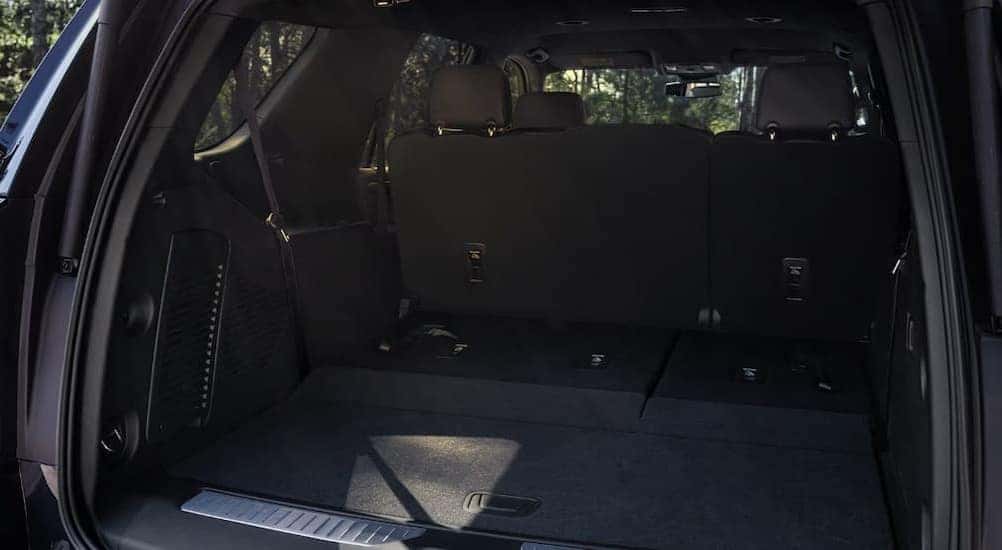
The difference in cargo space is more dramatic. Compared to the Tahoe, the Suburban has an extra 16 cu.ft. of space with all of the seats upright. Fold down the third row, and the difference between the two grows to 21.3 cu.ft. With both of the back rows of seating folded down, the Tahoe boasts an impressive 122.7 cu.ft. of cargo volume, but the Suburban outdoes it by 21.8 cu.ft., bringing the total up to 144.5 cu.ft.
Clearly, the Suburban is the better choice if you’re looking for as much cabin space as possible. It can more comfortably seat adults in its third row and has more room for bulky cargo. Depending on what you need to fit into your SUV, the Tahoe’s size might end up being a dealbreaker.
Price
As you might expect, that extra space comes at a cost. It simply takes more materials to build a larger vehicle, which makes it more expensive. So while the 2026 Suburban has a starting MSRP of $63,700, the Tahoe starts at $60,700.[a] This $3,000 price difference holds steady across the trim lineup (Tahoe RST vs Suburban RST, etc.).
This price difference might put the Suburban out of reach for you altogether, but not necessarily. If you were thinking of getting a Tahoe LT, you could instead opt for an entry-level Suburban LS for the exact same starting MSRP. It all comes down to your individual needs: would you prefer to have more space or more comfort features?
Capability & Performance
Because the Chevy Tahoe and Suburban use the same engines, producing the same amount of power, the Tahoe’s smaller size gives it a few other advantages. For one thing, it can accelerate more quickly, giving you more freedom to maneuver on highways like I-20 or two-lane country backroads where passing slow-moving vehicles can be tricky.
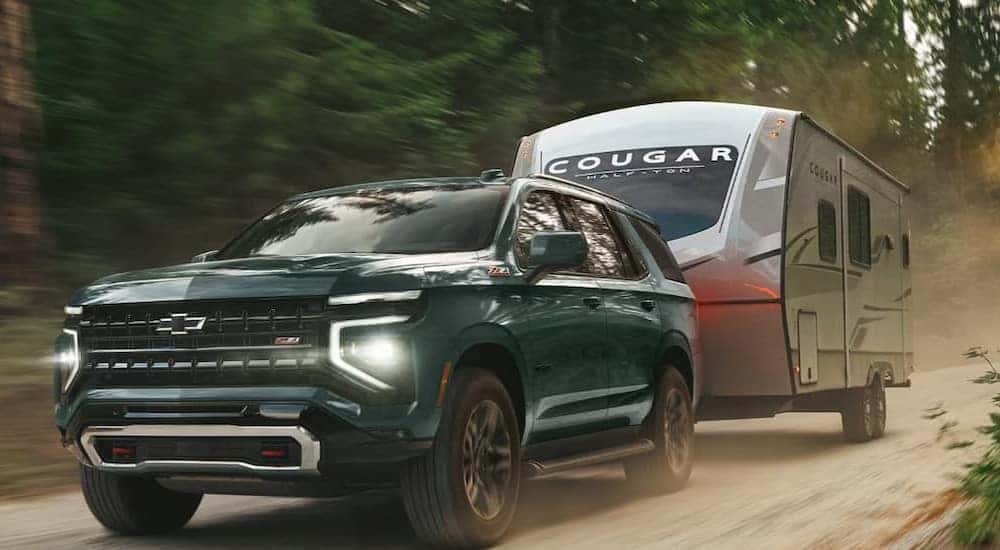
If you’re planning on bringing a trailer along for the ride, whether you’re bringing a boat up to Cross Lake or just transporting bulky items back home to Bossier City, you’ll also want to keep in mind the difference in towing capacity. Because the Suburban is using some of its engine’s power to carry its extra length and weight, it doesn’t have as much capacity left over for towing. The difference isn’t huge (200 lbs for the gas engines and only 100 lbs for the diesel), but depending on the weight of your trailer, it might make a big difference to you. If you want to be able to tow up to 8,400 lbs, then the Tahoe is the right SUV for you.
Basically, drivers who value performance and capability might want to lean toward the Tahoe. Not only are you getting faster acceleration and more towing capacity compared to a comparable Suburban model, but you also have more buying power, allowing you to upgrade to the engine that best suits your needs.
Fuel Economy & Range
Because the Tahoe is more lightweight, it also gets better fuel economy, though the advantage is pretty slim. The most efficient Suburban (one that pairs the diesel engine with rear-wheel drive) is rated at an EPA-estimated 23 MPG for city/highway combined driving. A Tahoe with the same combination is rated at an EPA-estimated 24 MPG. This 1 MPG difference is as big as it gets. In some cases, the difference is so slight that it rounds out to the same figure (for example, if you pair the base engine with rear-wheel drive, both the Tahoe and the Suburban get an EPA-estimated 17 MPG combined). Unless you’re really conscious about nickels and dimes spent at the gas station, this difference shouldn’t be a big concern.
If you’re more concerned about how far you can go on a single tank of gas, then there’s one more wrinkle worth mentioning. While the Tahoe is more fuel-efficient, the Suburban’s extra size gives it room to fit a larger fuel tank onboard. Depending on the configuration, this extra tank volume can allow it to go anywhere from approximately 40 to 88 miles further than a comparable Tahoe on a single tank of gas.
Drivers just looking for a daily driver that can get them around Bossier City don’t need to worry about this category much at all. But if you’re often out on road trips or long-haul towing rides and want to minimize the time you spend pulling over and fuelling up, the Suburban might come out on top.
Find the Right SUV for You Here at Chevyland
As you can see, there are many pros and cons to consider when choosing between these two SUVs. After all, if one were simply “better” than the other, it wouldn’t make sense for Chevy to make both. That means this decision comes down to your own individual needs. Here at Chevyland, we care about you, and we want you to have just the right vehicle for getting around Bossier City & beyond. If you’re still not sure which to pick, our team is more than happy to answer your questions and help match you up with your perfect match.
0 comment(s) so far on What’s the Difference Between the 2026 Chevy Tahoe & Suburban?